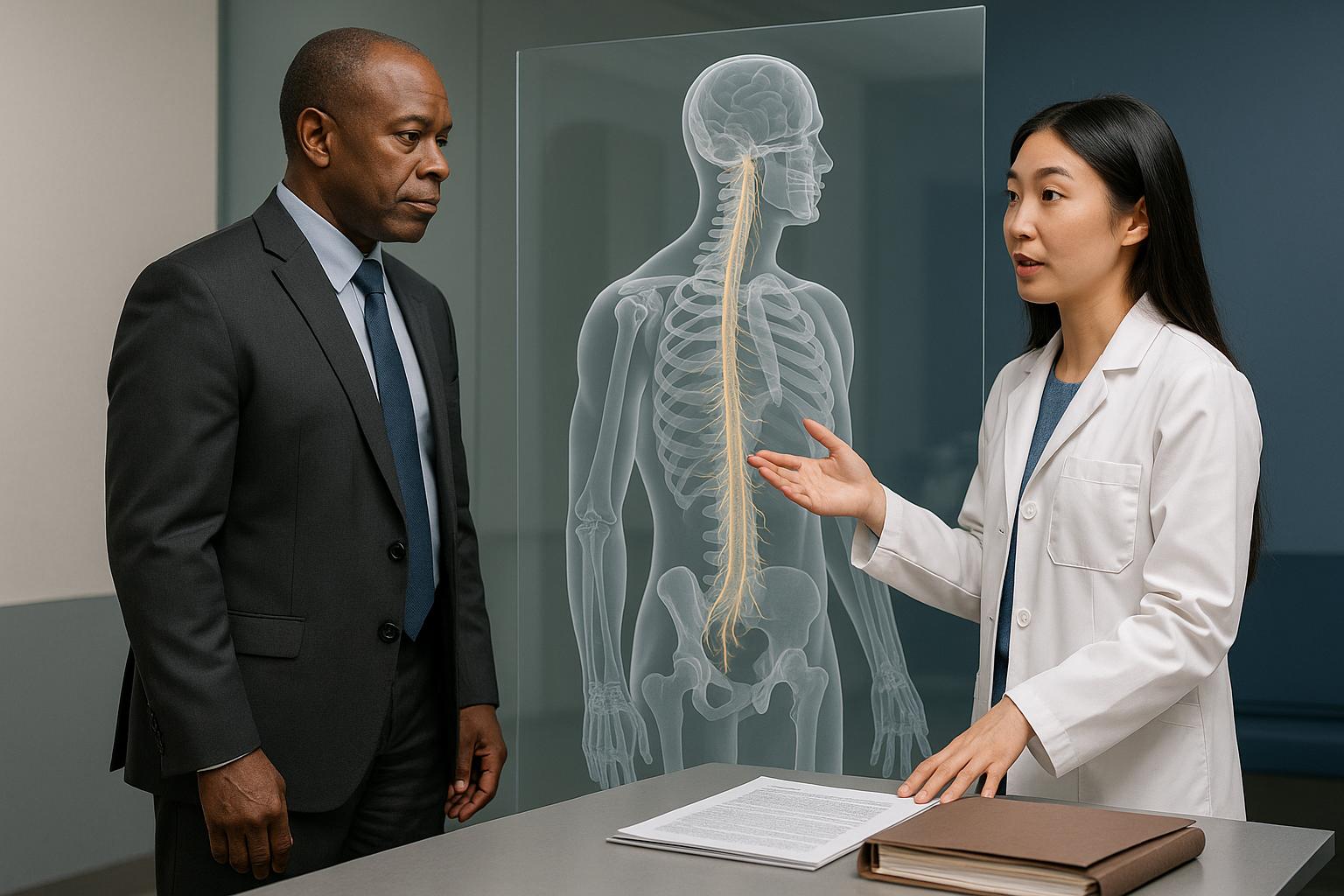
Independent Medical Examination: Why Objective Clinical Scrutiny Matters Most
By Ellia Ciammaichella, DO, JD
Triple Board-Certified in Physical Medicine & Rehabilitation, Spinal Cord Injury Medicine, and Brain Injury Medicine
Quick Insights
An independent medical examination is an objective evaluation performed by a physician not involved in the patient’s treatment. The examiner reviews medical records, conducts a physical assessment, and provides an unbiased opinion on diagnosis, causation, or impairment. Unlike treating physicians who advocate for their patients, IME physicians maintain neutrality. IME findings are often scrutinized in legal proceedings to assess their validity.
Key Takeaways
- IME reports must follow evidence-based clinical guidelines to withstand legal scrutiny and cross-examination.
- Board certification in relevant specialties ensures the examiner understands complex injury mechanisms and functional limitations.
- Proper credentialing standards require specific training in interventional procedures when evaluating prior spine care.
- IME physicians assess whether treatment aligned with current medical standards and realistic outcome expectations.
Why It Matters
IME findings are often scrutinized in legal proceedings to assess their validity. An independent medical examination conducted by a physician with expertise in both clinical practice and medicolegal assessments may integrate medical findings with legal considerations. This combination may help ensure reports address causation, impairment, and prognosis in language courts understand while maintaining medical accuracy.
Introduction
As a Reno, Nevada-based board-certified physiatrist and attorney, I evaluate medical evidence in legal contexts where objectivity matters most. You can learn more about Dr. Ciammaichella and the medical and legal expertise that inform this approach.
An independent medical examination is an objective evaluation performed by a physician not involved in the patient’s treatment. The examiner reviews medical records, conducts a physical assessment, and provides an unbiased opinion on diagnosis, causation, or impairment. Unlike treating physicians who advocate for their patients, IME physicians maintain neutrality.
Evidence-based guidelines for interventional techniques establish the framework for evaluating whether prior spine care aligned with current medical standards. My dual training allows me to assess both clinical appropriateness and legal relevance. This combination ensures reports address causation and functional limitations in language courts understand, while maintaining medical accuracy.
IME findings are often scrutinized in legal proceedings to assess their validity.
What Is an Independent Medical Examination?
An independent medical examination is a one-time evaluation performed by a physician who has no prior treatment relationship with the patient. I review all available medical records, conduct a physical examination, and provide an objective opinion on specific medical questions posed by the requesting party. These questions typically address diagnosis, causation, impairment level, or whether treatment is aligned with accepted standards.
The examination differs fundamentally from ongoing clinical care. I do not prescribe medications, order tests, or establish a treatment plan. My role is to analyze existing medical evidence and provide an unbiased assessment.
Clinical practice guidelines emphasize informed consent and risk-benefit discussions when evaluating whether prior interventional procedures met current standards.
In my practice, I focus on whether medical documentation supports the conclusions drawn by treating physicians. This requires understanding both the clinical presentation and the legal context in which the evaluation occurs.
The Medical Expert’s Role in IME Evaluations
My role in an independent medical examination centers on objective analysis rather than advocacy. I assess whether diagnoses are supported by clinical findings, whether causation opinions align with medical evidence, and whether functional limitations match documented impairments. This requires distinguishing between subjective complaints and objective clinical signs.
When evaluating prior interventional care, I consider whether the treating physician followed evidence-based protocols. Credentialing guidelines for interventional procedures establish minimum qualifications for physicians performing complex spine interventions. I examine whether the practitioner had appropriate training and whether the procedure was indicated based on the patient’s clinical presentation.
In cases involving spinal cord injury or traumatic brain injury, I evaluate whether functional limitations are consistent with the injury level and mechanism. My dual training allows me to identify gaps between medical evidence and legal claims without crossing into legal advocacy.
If you’re interested in a deeper dive into how recovery milestones are evaluated after spinal cord injury, additional resources are available.
Evidence-Based Standards in IME Practice
Evidence-based medicine provides the framework for evaluating whether prior treatment decisions were appropriate. I compare the care provided against published clinical guidelines and systematic reviews. This approach ensures my opinions withstand scrutiny under cross-examination.
Network meta-analysis demonstrates the need for careful patient selection when considering interventional spine procedures. Many interventions show minimal benefit over sham procedures for chronic axial spine pain. When reviewing prior care, I assess whether the treating physician documented appropriate patient selection criteria and realistic outcome expectations.
ASIPP’s comprehensive guidelines on epidural interventions provide evidence levels for long-term benefit assessment. I use these guidelines to determine whether repeated procedures were medically justified or represented unnecessary care. This analysis requires understanding both the clinical indication and the documented response to prior interventions.
In my evaluations, I distinguish between procedures supported by strong evidence and those with limited or conflicting data. This distinction matters when assessing whether treatment aligned with accepted medical standards at the time it was provided.
My objective medical-legal consulting services support legal teams and insurers seeking expert guidance on the standard of care, causation, and impairment evaluation.
Qualifications That Matter in IME Experts
Board certification in relevant specialties ensures the examiner understands injury mechanisms and functional limitations. My triple board certification in Physical Medicine and Rehabilitation, Spinal Cord Injury Medicine, and Brain Injury Medicine provides specialized knowledge of complex neurologic injuries.
This training is essential when evaluating causation in cases involving spinal cord injury, traumatic brain injury, or stroke-related disability.
Multisociety guidelines on safety considerations emphasize procedure-specific risk assessment for interventional procedures. When evaluating prior interventional care, I consider whether the treating physician had appropriate credentialing for the procedures performed. This includes training in fluoroscopic guidance, understanding of anatomic landmarks, and knowledge of potential complications.
My legal training allows me to understand what questions need answering and how to present medical opinions in legally relevant terms. I focus on causation analysis, functional capacity assessment, and whether impairments are permanent or temporary. This combination of clinical expertise and legal understanding produces reports that address the specific issues in dispute.
How IMEs Differ from Treating Physician Evaluations
Treating physicians advocate for their patients and focus on maximizing recovery. This advocacy role is appropriate in clinical care but creates inherent bias in legal contexts. I maintain neutrality by evaluating medical evidence without considering which party requested the examination.
Treating physicians often accept patient-reported symptoms at face value and document them as objective findings. In an independent medical examination, I distinguish between subjective complaints and objective clinical signs. This distinction matters when assessing whether functional limitations are supported by medical evidence.
Systematic review of neuromodulation therapies provides evidence levels for specific indications and outcome expectations. When treating physicians recommend advanced interventions like spinal cord stimulation, I evaluate whether the patient met established criteria and whether less invasive options were exhausted. This analysis requires understanding both the evidence base and the patient’s clinical trajectory.
In my evaluations, I assess whether the medical record supports the opinions expressed by treating physicians. This includes reviewing diagnostic test results, treatment responses, and functional assessments. My goal is to provide an objective analysis that helps resolve medical disputes without advocating for either party.
My Approach to Independent Medical Examinations
In my clinical practice evaluating individuals with spinal cord and brain injuries, I’ve found that the most defensible IME reports combine rigorous clinical assessment with clear legal relevance. My dual training as both a physician and attorney allows me to understand what questions need answering and how to present medical opinions in terms that courts can apply.
From my unique perspective with both medical and legal credentials, I can translate complex medical findings into precise documentation that addresses causation, functional limitations, and prognosis. When evaluating prior interventional care, I assess whether treatment aligned with evidence-based guidelines and whether the practitioner had appropriate credentialing for the procedures performed.
My approach emphasizes distinguishing between subjective complaints and objective clinical signs—a critical distinction when functional limitations are disputed. I focus on whether medical documentation supports the conclusions drawn, not on advocating for either party.
Having worked with hundreds of cases involving spinal cord injury, traumatic brain injury, and complex spine interventions, I’ve learned that objective analysis requires understanding both the clinical presentation and the legal context in which opinions will be scrutinized.
Individual case outcomes vary based on specific medical evidence and legal standards applicable to each jurisdiction.
Conclusion
In summary, an independent medical examination provides objective analysis when medical evidence requires neutral evaluation. As a physician and attorney, I assess whether diagnoses align with clinical findings, whether causation opinions withstand scrutiny, and whether functional limitations match documented impairments.
Evidence-based guidelines for interventional techniques establish the framework for evaluating whether prior care met accepted standards at the time it was provided.
My dual training allows me to bridge clinical expertise with legal requirements, producing reports that address causation, impairment, and prognosis in terms that courts can apply. When evaluating prior interventional spine care, I compare treatment decisions against current procedural standards and best practices to determine whether care was appropriate and whether outcomes were realistic.
Based in Reno, Nevada, Dr. Ellia Ciammaichella provides medical-legal services through Ciammaichella Consulting Services, PLLC, across licensed states such as Texas, California, and Colorado. I am available to travel for expert testimony and in-person evaluations when appropriate. This flexibility allows individuals and legal teams with complex cases to access consistent, expert analysis regardless of location.
I invite you to request a consultation today to obtain an objective medical analysis that addresses both clinical accuracy and legal relevance. Whether your case involves spinal cord injury, traumatic brain injury, or complex interventional spine care, my combined medical and legal perspective ensures defensible opinions that withstand expert scrutiny.
This article is for educational purposes only and should not be used as a substitute for professional medical advice, diagnosis, or treatment. Always seek the advice of your physician or other qualified healthcare provider with any questions you may have regarding a medical condition or treatment options. Never disregard professional medical advice or delay in seeking it because of something you have read in this article.
Frequently Asked Questions
What makes an IME different from a regular medical evaluation?
An independent medical examination is performed by a physician with no prior treatment relationship to the patient. I review medical records, conduct a physical examination, and provide objective opinions on specific questions posed by the requesting party.
Unlike treating physicians who advocate for their patients, I maintain neutrality and distinguish between subjective complaints and objective clinical findings. My role is to analyze existing medical evidence rather than establish ongoing care or prescribe treatment.
How do you evaluate whether prior interventional spine care was appropriate?
I compare treatment decisions against evidence-based clinical guidelines and systematic reviews published at the time care was provided. This includes assessing whether the treating physician documented appropriate patient selection criteria, whether the practitioner had proper credentialing for procedures performed, and whether realistic outcome expectations were established.
I examine whether repeated interventions were medically justified based on documented response to prior treatments and whether care aligned with accepted medical standards.
Can you provide IME services if I’m located in another state?
Yes. I provide medical-legal services across multiple licensed jurisdictions through comprehensive record review and telemedicine consultation. I am available to travel for in-person evaluations and expert testimony when appropriate.
This multistate capability ensures legal teams and individuals with complex cases can access specialized medical-legal expertise regardless of geographic location.
About the Author
Dr. Ellia Ciammaichella, DO, JD, is a triple board-certified physician specializing in Physical Medicine & Rehabilitation, Spinal Cord Injury Medicine, and Brain Injury Medicine. With dual degrees in medicine and law, she offers a rare, multidisciplinary perspective that bridges clinical care and medico-legal expertise. Dr. Ciammaichella helps individuals recover from spinal cord injuries, traumatic brain injuries, and strokes—supporting not just physical rehabilitation but also the emotional and cognitive challenges of life after neurological trauma. As a respected independent medical examiner (IME) and expert witness, she is known for thorough, ethical evaluations and clear, courtroom-ready testimony. Through her writing, she advocates for patient-centered care, disability equity, and informed decision-making in both medical and legal settings.